
Chris Moyer
Founder & President
CERAWeek is so much more than an oil and gas conference. My colleague Dan Crawford and I made the trek to Houston last month for the first time, with several goals. First, don’t get stuck in laughably long TSA lines (mission accomplished, thank you Hobby Airport). Second, spend time with our next-generation geothermal client and help them hone their presentation. Third, hobnob with reporters at the Politico Pub. Fourth, talk to as many companies as we could about their approach to federal policy.
On this last point, it was striking to see the number of clean tech companies, at various stages of maturity, sharing their work with audiences ranging from 10 to 100 people. A stroll down the 3rd level of the George R. Brown Convention Center—dubbed the Innovation Agora, where peons like us paid a mere $3,000 for entry—revealed executives from companies ranging from fusion to geothermal to long-duration energy storage startups.
Best (or worst) in show: the green hydrogen company founder who spent 75% of his presentation explaining why his own business model was a bad idea with a litany of hurdles.
While we’re at it: I also enjoyed stopping by the Greentown Labs headquarters and talking with some of the entrepreneurs working away at innovations that could literally change the world. The vibes were good, as the kids would say. My only qualm was the tech investor who described working with the Department of War. I couldn’t help myself and noted that it takes an act of Congress to actually change the name.
The Politico Pub was a must-attend event, especially Tuesday night when two cabinet secretaries spoke in the crowded and noisy downtown bar. But it’s deeply frustrating that despite an impressive roster of energy reporters available to them, Politico chose Jonathan Martin to interview Secretary Doug Burgum. It’s not a knock on Martin—he’s one of the top political reporters around—but the lack of follow-up on Burgum’s claims about the “unreliability” of solar and wind was noticeably absent. Any number of Politico’s energy reporters on site would have instinctively pushed him on the role of batteries and storage in stabilizing the grid…
In one of the more predictable occasions on the calendar, the President recently released his budget and drew uproar from various industries and groups who were not funded at the levels they desire. While it’s a messaging opportunity for everyone involved, the substantive impact will be minimal. For all the well-placed handwringing about Congress abdicating its power to the executive branch, they still routinely ignore much of a president’s budget proposal. Expect that to happen again…
As the war with Iran has continued and disrupted the world economy—raising prices on everything from gasoline for cars to fertilizer for farmers smack in the middle of planting season—Trump needs a win before the midterm elections to show he and Republicans are taking action to make life more affordable. Democrats, to the contrary, have no reason to give the President and their GOP colleagues a victory that could help their chances in November. Big, bipartisan legislation only happens when political incentives are aligned.
Politics aside, the restrictions of the calendar just don’t support the idea that permitting reform legislation can cross the finish line before early November. Assuming bill language is ready for review in August, Congress will only be in session for about two weeks in September before adjourning for the final stretch of campaigning. This feels like a lame duck play.
Yet consider me skeptical that anything will pass even in November or December. Democrats, likely on the verge of regaining control of the House at that point, will have every incentive to hold out for more favorable legislation in 2027. Even with a Democratic House majority, a wishlist bill isn’t going to survive a presidential veto. Lame duck passage will only be possible if both parties see upside in compromising.
Congress repeats this cycle with exhausting regularity, and yet the fundamental crisis of our slow, sclerotic permitting process remains. But the pressure—from the grid, from industry, and from the sheer cost of project delays—is reaching a breaking point. Eventually, the political cost of doing nothing will finally outweigh the cost of compromise. The law will change; Congress just seems determined to do it the hard way…
If you thought reconciliation—the budget legislation that requires only a simple majority to pass the Senate—was done with the One Big Beautiful Bill Act’s passage last July, think again. GOP leadership is now crafting a second reconciliation bill, which Trump wants on his desk by June 2, and they could embark on a third after that.
The next reconciliation bill is expected to focus narrowly on funding for ICE and CBP, which have been shut down for the last two months. A third reconciliation package is where House Republicans’ wishlist, which includes several energy provisions, could materialize. There’s not much left on the bone to attack given how effectively they dismantled clean energy policy last year, but they aim to gut efficiency mandates, take a sledgehammer to the federal regulatory process and choke off the flow of federal grants and subsidies.
Yet because of limited calendar time, a narrow House majority, and the lack of looming tax increases pulling together all Republicans, it’s hard to see this coming together. Endangered House Republicans would be wise to put forward messaging legislation on energy to restore the IRA tax credits to soften the blow from an onslaught of attacks that will only increase in the months ahead…
No one expects this to pass now, but that’s not the point. It’s a bill Democrats around the country can rally around on the campaign trail to talk about bringing down electricity bills. It is a foundational piece of the energy agenda Democrats will pursue if they regain the House majority in January, and it will inform policy for a potential Democratic president in 2029…
We really need a “Climate Week Czar” to ensure overlapping Climate Weeks never happen again. San Francisco and DC Climate Weeks both commence next week, which I understand is because organizers of both wanted theirs to coincide with Earth Day. But they shouldn’t have to compete with each other…
They should follow the model of the successful solar and wind developers who commit the time to earning support for their projects from communities transparently. Much of the blowback has centered around NDAs local governments have signed with mystery companies. Exhibit A is the Missouri town that just voted out half its city council after it approved a data center project. While a congressional bill from AOC and Bernie Sanders banning data centers won’t pass, state and local bans like those in Maine and Wisconsin could catch fire and expand to other jurisdictions…
Finally, what a time to be working in energy policy. Energy is the center of everything these days: geopolitics (Iran, Venezuela), electoral campaigns, the AI data center buildout, and more. Here’s to all the energy professionals working doggedly to solve seemingly intractable energy and climate challenges in a difficult environment.
Check out our recent insights and conversations:

The Growing Political Clout of Martin Heinrich
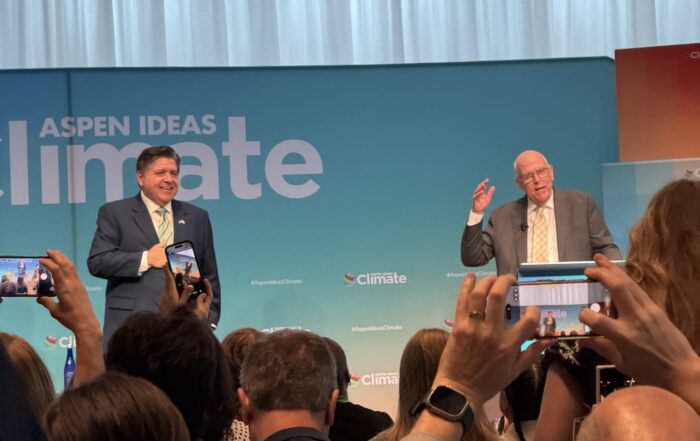
Climate Activism and the AI Buildout Come to a Head
Chip Roy Messed With Clean Energy. He Paid the Price.
Sign up for our newsletter
Receive updates on our work, industry news, and more.