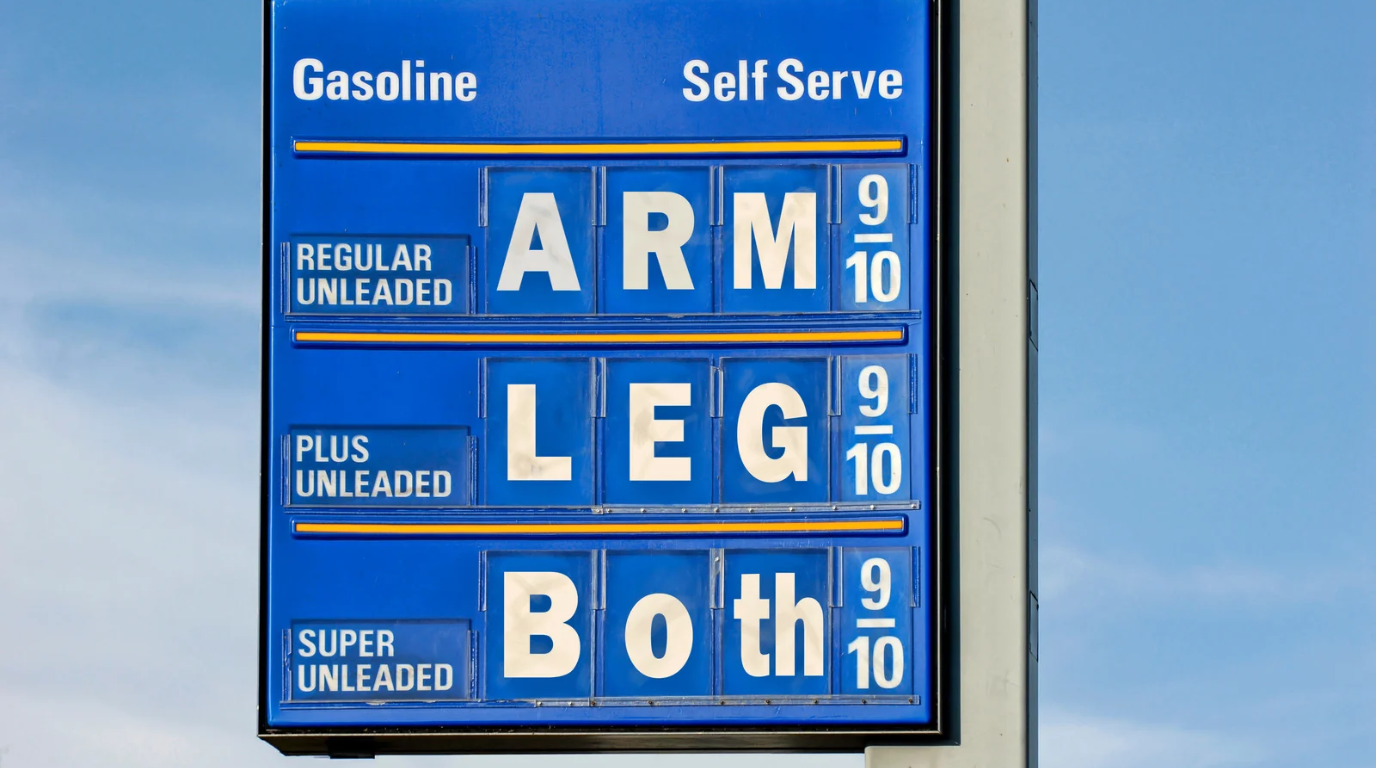

It’s hard to miss the giant billboards on New Hampshire Route 16, a road that traverses the seacoast to the Mount Washington Valley.
“Republicans are giving us gas pains,” one says in massive lettering next to an illustrated gas pump.
“Prices keep climbing. Hold Republicans accountable,” another says.
In rural New Hampshire and Maine — where two competitive races are being waged over key U.S. Senate seats — the prices at the pump themselves are as much of a political advertisement. The region’s fall foliage has been a spectacular mosaic of vibrant red, orange and yellow trees this year, and tourists and hiking enthusiasts paid a premium to fill up their tank to take in the views.
On Route 16, a line of cars recently waited to fill up at a gas station that boasted $4.10 per gallon gas (the member price, with everyone else paying $4.20). The link between President Donald Trump’s war in Iran and an expensive tank of gas is hammered home at select stations that have been lightly vandalized with Trump “I did that!” stickers that featured a grinning president pointing towards the climbing numbers at the pump.
It’s not just gasoline; the price of an oil change has risen everywhere, too. Some mechanics are being blunt about why; a friend getting their car worked on at their local mechanic shop spotted a colorful hand-written notice to customers: “Oil change prices have increased, due to s**t-head DT.”
Trump’s Iran imbroglio has underscored the global nature of the oil market, and how embedded it is into nearly every facet of our lives. For months, elevated prices have risen on news of attacks in Saudi Arabia, fallen on rumors of a peace deal, and risen again due to yet another distant event.
While oil companies rake in record profits, most Americans are anything but flush with cash — and they’re likely to respond accordingly at the polls on Tuesday.
Voters all over the nation are dealing with the fallout from repeated oil shocks. But the crunch is heightened in various regions. Midwestern farmers in Iowa, Nebraska and other states are struggling with the exorbitant cost of diesel. In resource-rich Alaska, voters in certain areas are paying over $7 a gallon for gasoline, and power plants that burn diesel to create electricity are also digging into voters’ pocketbooks.
It’s of course too soon to know how accurate midterm polls are, but they suggest that high energy costs are putting deep red states once seen as far out of reach for Democrats seriously in play.
The Looming Winter Heating Crisis
In New England, the colder temperatures and shorter days are putting the spotlight on the exorbitant cost to stay warm this winter. Heating oil is dominating the political ad wars here. Just 3% of the U.S. still heats with oil, but the vast majority is concentrated in the region.
Last year, the average cost for a gallon of heating oil was $2.60, according to the US Energy Information Administration. This year? A whopping $6.14.
The recent release of startling Consumer Price Index numbers measuring inflation said it all: heating oil prices jumped 74 percent compared to last year, followed by gas prices at over 34 percent. Natural gas and electricity prices — although still inflated compared to 2025 — had risen more modestly, at 5.0 percent and 4.4 percent, respectively.
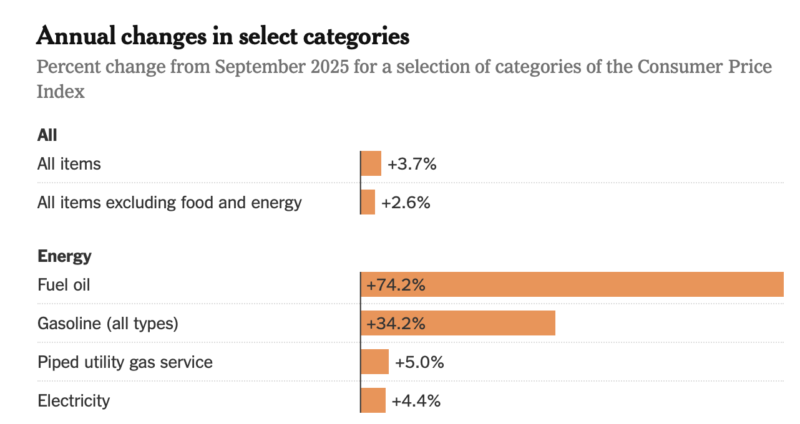
From the New York Times
Echo Chamber readers might remember my first newsletter talking about my nascent relationship with heating oil, as a renter in a drafty, old Massachusetts house.
After much time trying unsuccessfully to guess the direction of future prices, I finally purchased my first oil order of the season — making a bet that prices would keep rising before they went down, due to higher winter demand and the possibility of additional Middle East conflicts. And as predicted, my bill was indeed double.
Further north, Maine Republican Sen. Susan Collins is facing a challenge from Democrat Troy Jackson, and both candidates have sought to portray themselves as more responsive to their constituents’ energy woes.
Last year, the Trump administration’s Department of Government Efficiency proposed cutting the entire budget for the Low Income Home Energy Assistance Program — an essential lifeline that helps families pay for winter heating costs.
Collins, who chairs the powerful Senate Appropriations Committee, has touted her ability to not only keep the program intact, but add $20 million to it.
However, it remains to be seen how much this increase expands the program’s reach, given how much pricier heating oil is this year. The Trump administration has also released part of a federal home heating oil reserve in a last-ditch attempt to alleviate prices, but the damage may have already been done in voters’ minds.
It is clear voters in most corners of the country are frustrated by their rising bills. In less than a week, we’ll get a clearer picture of how spiking energy costs drove voters to send a message to an incumbent party that’s failed to deliver on its promises to make energy cheaper.