Morgan Caplan
Senior Communications Manager
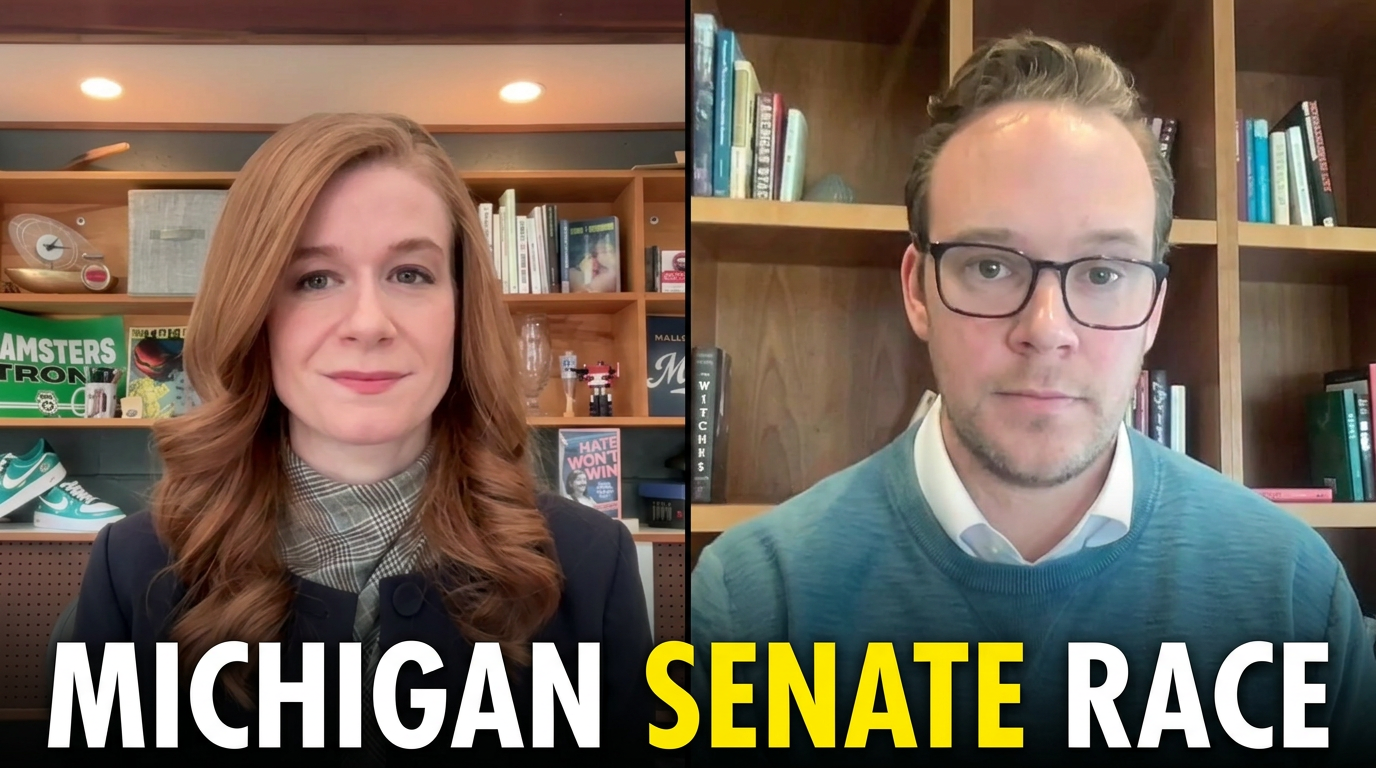
The perennial battleground state of Michigan is hosting a critical and hard-fought campaign for the US Senate this year after incumbent Democrat Gary Peters announced his retirement. It’s a seat that Democrats must hold if they’re going to have any shot at regaining control of the upper chamber of Congress. While Republicans have coalesced once again around Mike Rogers, the three-way Democratic primary is getting more and more contentious by the week. Today, we are pleased to welcome one of those candidates seeking the Democratic nomination, Mallory McMorrow.
Mallory has been State Senator since 2019, and we wanted to hear from her about energy affordability, how rising electric bills are affecting her constituents, and what she wants to do about it if elected to the US Senate.
Chris Moyer: Much of our audience has likely heard about you, perhaps beginning four years ago when you burst onto the national stage with your powerful speech in the state legislature. Could you share more about yourself and why you’re running for the U.S. Senate?
Mallory McMorrow: I am currently the State Senate Majority Whip. I’m the first woman to hold that position and the first Democrat in nearly 40 years. But I am somebody who Googled how to run for office after the 2016 election. I had never done this before. I had a very different career in car design, media advertising before coming into this work. But I was just absolutely horrified by a politics that was about tearing some people down to lift others up, and that was running all the way down into our state level.
On the state level in Michigan, Republicans had controlled the State Senate since 1984. So in my first run for office, I challenged my State Senator, who was the Republican incumbent. He had won by 16 points. We beat him by four. So we swung a district 20 points in a single cycle in my first ever run for office with more than 500 volunteers in a district nobody thought we had any business running in.
And the big issue then was people looked at me and said, you remind me so much of my daughter who left Michigan. Why are you here, and what can we do to bring our kids back? And that was the umbrella for everything we did — whether it was civil rights, voting rights, protecting our water, creating economic opportunity, diversifying our economy, you name it, that went into that agenda.
Then you mentioned the speech that some people may know me by. On the backend of that speech, I opened up a state PAC. I leveraged the platform I had been suddenly given to raise millions of dollars for a dozen other candidates running for state senate, campaigned all across the state for all of them, and helped flip control of the state senate for the first time since 1984.
And when we took full control in the state legislature, we governed like we give a damn. We protected our water. We expanded civil rights. We expanded voting rights. We passed the strongest clean energy legislation in the Midwest at the time, creating jobs that pay $100,000 and above and bringing labor to the table with environmental groups. We repealed a seniors pension tax, expanded access to affordable housing.
We did so much good work. And all of that is why I’m running for U.S. Senate right now, because Washington is fundamentally broken, and we have a blueprint right here in Michigan for how to fight everywhere, how to win, and how to actually deliver for people that I want to bring with me.
CM: So when you first ran in 2018, cost of living was certainly not the issue that it is today. I’m curious to hear about folks from both parties, from across the political spectrum—that consistently shows up as their top concern. And I think specifically thinking about utility bills and energy affordability, what are you hearing from voters across the state, and what’s your message to them?
MM: Michigan is often the canary in the coal mine because we are so directly attached to the auto industry. Things like tariffs and the global economy hit us especially hard here. We are a border state. A lot of people don’t remember that. We border Canada. A car might cross the border between Michigan and Canada up to a dozen times in the process of assembly. So the tariffs can lead to the price of that new vehicle being $10,000 above what the MSRP was.
We also were a state that was leading the EV revolution, and the removal of the tax credits for EVs—as you can imagine—it plummeted EV adoption, because $7,500 is a lot for any family to take on. And it led to Ford posting a $19.2 billion loss, GM posting a $9 billion loss, because they had to retool all of their plants, and they laid thousands of people off across our state.
So it’s not just energy costs. That is real. People are feeling the crunch of utility bills and seeing our utilities come back almost immediately in this cycle of asking for rate increases right after they’ve received one. And you combine that with one of the highest unemployment rates in the country and the uncertainty around the tariffs and the global economy thanks to this president, people are really feeling the squeeze. If you have been laid off and you’re on unemployment—that’s what my office deals with every day, with people who are navigating that process right now—you can’t afford an increase to your energy bill.
We’re also hurt because, as I mentioned, we passed the strongest clean energy legislation a few years ago, and the president is really threatening that progress. Whether it is a solar field that was 90% complete that his policies prevented from coming back online or forcing a coal-fired power plant to stay on the grid, even when the CEO of Consumers Energy said, “we have planned to decommission this plant,” it really hurts everybody.
CM: You mentioned the clean energy legislation that you all passed in the legislature a few years back. I imagine then, the framing of it was largely around climate change in addition to the economic benefits, of course. We’ve seen a real decisive turn away from talking about climate change since January of last year. And I’m curious how you think about balancing addressing climate goals, which are still important for a significant slice of the Democratic primary electorate, with affordability concerns. Do you view those two as conflicting or is the message shift kind of a way to more effectively meet voters where they are and bring them in when maybe climate itself wasn’t resonating?
MM: Michigan is a unique state because we are the Great Lakes state, and one issue that cuts across party lines is protecting the lakes, protecting our water. That is something, even when I am campaigning in deep Republican districts. My Republican colleagues in the state senate, as I’m in those areas, they’ve been giving me some advice and they said, “the only thing you have to talk about out here is protecting the water.” That is core to who we are, so I don’t view these issues in conflict.
And actually right now, I think there’s a huge opportunity for those of us who believe in clean energy, those of us who have fought for that for years, to take the mantle back. At a moment when gas prices have suddenly skyrocketed again, you’ve seen even coverage in the Wall Street Journal as all of a sudden, people are taking a hard look at EVs again because of the freedom aspect of it. That’s always been how we’ve talked about clean energy. Yes, climate change is hugely important, but so is the freedom to know that you’re not dependent on a global oil market to put gas in your car, that you can plug in at night, that we can bring on wind, solar, renewables to power your vehicle at a much cheaper rate than gas prices are right now.
And that our shift into clean energy creates massive economic opportunity for our state. These are jobs that, on average, pay $100,000 and above. Michigan became the number six state in the country for new clean energy jobs. And it’s a sense of pride for us. We are the manufacturing state that is also the Great Lakes state. We’ve always been both, and that’s how we position it. So I think that these things go together, and they’re not a conflict.
CM: Data center development has become a real contentious issue across the country and certainly in your state. You recently released a plan to put guardrails around data center development. Your plan includes calls for banning non-disclosure agreements between local governments and hyperscalers, making sure developers pay for additional power generation, and requiring that at least 90% of their projected electricity needs come from renewable sources. Talk to us about this plan. How did you come up with these ideas, these measures, and what’s been the reaction both from voters on the campaign trail and also from the industry. Have you heard from any of these big tech companies?
MM: I want to give credit to a couple of my colleagues, Representative Joey Andrews from Southwest Michigan and Senator Kevin Hertel, who have been working on these issues for years. Before the recent explosion of data centers, both of them saw that this was coming and wanted to get ahead of it.
So in the state legislature, we passed incentive legislation. Years ago, there was incentive legislation on the table that I voted against because I felt our residents didn’t get enough out of it. But our incentive legislation that is in law right now requires that for a company to receive the incentive, they have to use at least 90% renewable energy generation. It requires that ratepayers cannot subsidize the energy costs of that data center so residential energy rates cannot go up for that data center, that you must use a municipal water source, and you must use union labor. For us, that is the flag that we planted in the ground to say, “if you’re going to come into Michigan we’ve got the carrots there for you to do it the right way.”
I feel like Michigan is already set up because we are a state that is less prone to extreme weather events. We have a temperate climate. Obviously, we have access to a ton of water. We’re already incredibly attractive for these places to locate, so we can make sure they pay their fair share and they do it the right way. We do not need to bend over backwards and give them more than what benefits our residents. There are going to be billions of dollars that these companies are injecting into these projects over the coming years. And if we do this right, with real sensible guardrails around it, we can ensure that we are leveraging that investment to benefit all Michiganders.
So any data center that comes into Michigan cannot hurt our air or water, must use local union labor, must use, as we mentioned, 90% renewable energy, which will actually help us bring that investment into bringing new clean energy onto the grid not just for the data center but for all of us. And we can use that investment to actually, finally upgrade our grid, our transmission lines in ways that we’ve desperately needed in our state. And we can be the state again, as the manufacturing-meets-Great Lakes state that shows the rest of the country how to do this right.
CM: How’s the reaction been?
MM: It’s been good. It’s interesting on the ground. I think a lot of people are rightly freaked out because Big Tech tends to get its way. They barge in, if you look at Colossus down in Memphis, the Elon Musk xAI data center. That was exactly the wrong way to do it, where it was done kind of in the cover of darkness, and there was no transparency. Local residents are reporting higher rates of asthma, the noise is insane, the air pollution, the water quality. It is abysmal what has been done there and I think that that is the worst example of one of these things gone wrong.
But when we talk through with residents, in the same way that we revolutionize manufacturing, where our manufacturing facilities are clean, are safe, they use union labor, they respect our Great Lakes, we have strict water quality protection laws in place—when we make that parallel to say, “all of these things are not created equal, let’s do it the right way,” then they get it. Especially when we talk about how these tech companies have billions of dollars, let’s leverage those dollars to actually make your energy rates go down. When we talk about it that way, to say, “if they want to come into us, they better benefit us,” people are on board.
CM: And finally, what’s one thing about you that might surprise people?
MM: Ooh, one thing about me that might surprise people. I started my career as a car designer. There is actually a Hot Wheels car that has my name on it. So I went from designing real cars, but I graduated in 2008 so the industry collapsed, and as you can imagine, my career didn’t start. But I found my way in at Mattel and worked my way up to become a senior designer over global branding and licensing for Hot Wheels. So people could still afford our cars because they only cost $1. Pretty recession proof. My fun fact is a Hot Wheels car that has my name on it. So I’m playing the long game with four-year-olds.
Know someone who should be featured? Email us: info@echocomms.com.
Check out our recent conversations:
WATCH: Solar’s Journey From ‘Brink of Extinction’ to Manufacturing Renaissance
Echo’s Interview with Gov. Wes Moore
WATCH: Mike O’Connor on the Mountain West Geothermal Consortium & the Case for Faster Deployment
Sign up for our newsletter
Receive updates on our work, industry news, and more.