
Chris Moyer
Founder and President
With the 2026 midterm elections just 10 months away, energy affordability has moved from niche policy discussions to some of voters’ biggest concerns. Following 2025 elections in Georgia, New Jersey, and Virginia where “energy affordability” became a definitive buzz phrase, it’s clear that voters now view utility costs as a top-tier quality-of-life issue.
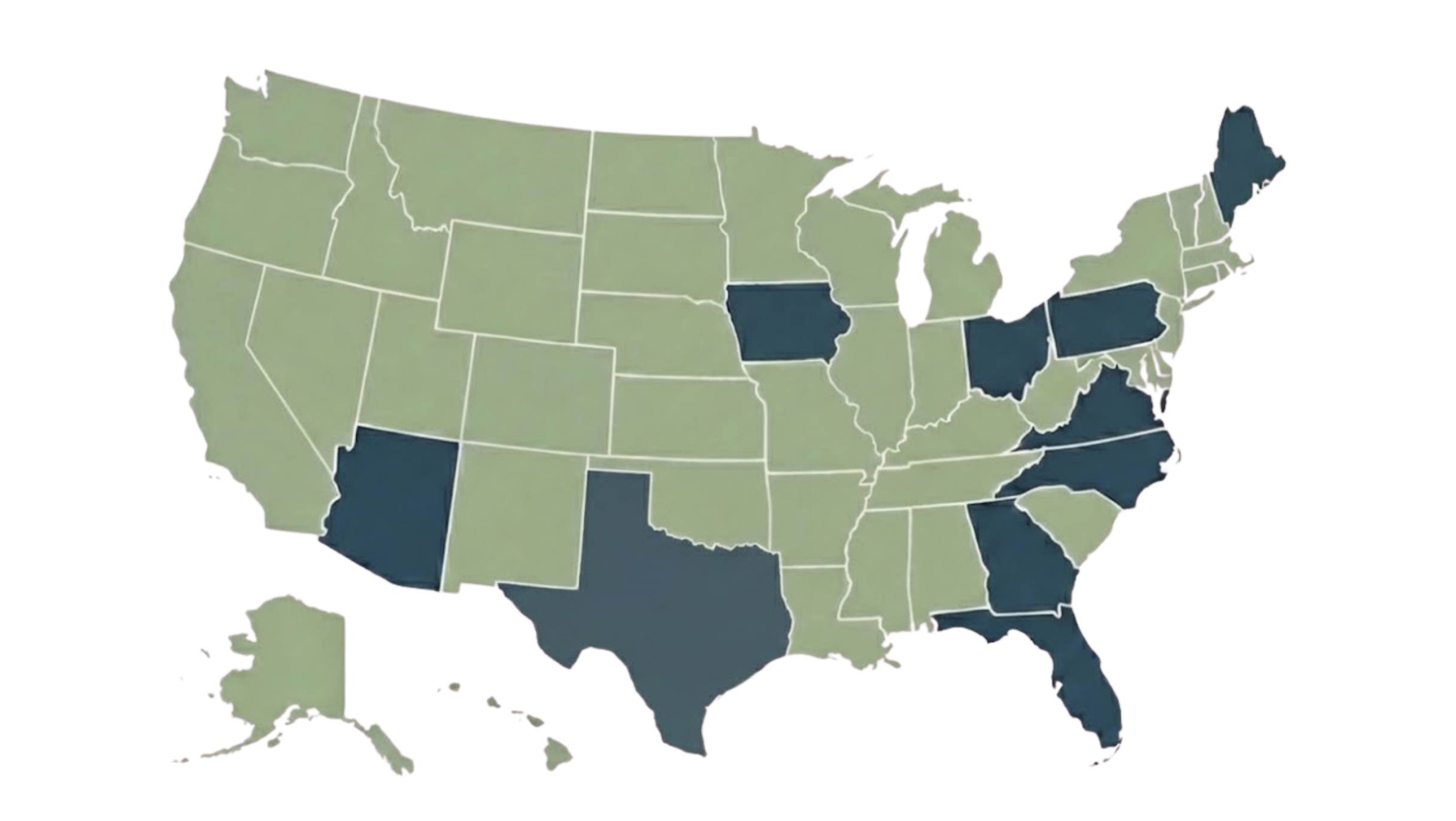
Today, Echo Communications Advisors is releasing a new report, The 10 Energy Affordability Battlegrounds, which identifies 10 key states where the intersection of rising residential electricity bills and a surge in data center development is poised to swing critical races that will determine control of the U.S. House, the U.S. Senate, and state governorships.
The report is the first in Echo’s Electoral Landscape series designed to provide clean energy stakeholders with actionable insights into the political landscape. (Sign up here to receive future reports.) Too often, we see a disconnect between clean energy companies and the campaign trail and how electoral considerations shape policy that affects their businesses.
The objective of this analysis is to help focus the collective clean energy community’s efforts this year. Specifically, we hope this report encourages clean energy executives and advocates to work closely with candidates to ensure that affordability messaging on the campaign trail translates to substantive policy progress that, once they’re legislating, actually advances clean energy development and deployment.
Factors in Our Analysis
Our analysis used a multi-layered approach to rank the top 10 states:
-
Price Shifts: We reviewed U.S. Senate Joint Economic Committee data comparing year-over-year average electricity prices from the EIA, which shows that residents in 47 states experienced increases from 2024 to 2025.
-
Data Center Implications: We looked at data center figures, both existing and planned or proposed, from the American Edge Project and local media outlets to see where rate hikes might be forthcoming. While the precise long-term impact on electricity bills is still unclear, messaging around potential cost increases for households due to data centers’ massive energy demand is highly resonant with voters.
-
Political Stakes: We prioritized states with competitive House seats, closely contested Senate races, and targeted gubernatorial contests that, collectively, will determine which party holds power in 12 months. We also factored in races for state utility regulator seats, which play a critical role in how much households pay.
-
Messaging: We reviewed messaging coming from candidates and incumbents to understand how both parties are framing energy affordability.
The Political Math
Democrats entered 2026 with growing confidence that a favorable environment will carry them to control of the U.S. House of Representatives, with capturing a Senate majority a much taller task. They argue that President Trump has failed to deliver on core promises of making daily life more affordable—voters’ top concern.
-
U.S. House: Republicans currently hold a narrow majority. Democrats need to net only a few seats—likely three—to secure the Speakership for Hakeem Jeffries.
-
U.S. Senate: Democrats must net four additional seats to grow their ranks from 47 to a 51-seat majority (since Vice President J.D. Vance is the tie-breaking vote). This would require holding seats in Georgia, Michigan, and New Hampshire, defeating incumbents in Maine and Ohio, winning the open seat in North Carolina and pulling off an upset in Alaska, Texas or Iowa.
-
Governorships: Republicans hold 26 governorships to Democrats’ 24. This balance could shift, though, as 36 states hold gubernatorial elections this year. Leadership in swing states could be critical if there’s a contested presidential election in 2028.
Key Findings: The 10 Energy Affordability Battleground States
The states below represent the critical battlegrounds where electricity costs will feature prominently in 2026 elections. It’s noteworthy that the proliferation of data centers is now inextricably linked to voters’ perceptions of rising costs. Even in states where electricity rates didn’t spike in 2025, such as Arizona and North Carolina, looming rate hikes of up to 14% are contributing to voter discontent.
-
Arizona: Residential bills rose only 1% last year, but the state’s largest utility is seeking a 14% rate increase. The state ranks 5th for existing data centers. Governor Hobbs is running for re-election, and three Republican House seats are in-play. Voters will also cast ballots for two seats on the state’s utility regulatory body.
-
Florida: Monthly payments increased by 9% last year (15th highest in the U.S.). Regulators recently approved a record $7B rate hike for Florida Power & Light. While voters will elect a new governor and choose Marco Rubio’s replacement in the U.S. Senate, three competitive House races could swing control in Washington.
-
Georgia: Although 2025 increases were a modest 5%, average bills for Georgia Power customers have risen by $43 monthly since 2022 and are likely to keep rising. More than 300 new data centers have been proposed. Senator Jon Ossoff must win re-election for Democrats to have a shot at regaining the majority. Two more Public Service Commission seats are up this year.
-
Iowa: Heating bills are expected to spike, and the elimination of federal wind energy tax credits could further crimp energy supply. Iowa currently generates 60% of its energy from wind. The state will elect a new governor, new U.S. senator and host three competitive House races.
-
Maine: Ranked 7th highest for increases, Mainers saw a 13% spike in 2025. Senator Susan Collins is defending her seat, which Democrats must win to regain a majority. The 2nd congressional district is also a highly competitive seat that both parties are vying for. Mainers will also elect a new governor.
-
North Carolina: Bills remain flat for now, but a 3% increase is projected for 2026, followed by a 14% spike in 2027. The open U.S. Senate race will be among the most expensive in the country as it could flip into Democratic hands for the first time since 2008. Two House races will also be closely watched for national implications.
-
Ohio: Ohioans faced some of the sharpest increases at 10%. The state ranks 5th for existing data centers. Voters will have a full ballot as they pick a new governor, decide if Sherrod Brown should return to the Senate, and help determine control of the House with three competitive races.
-
Pennsylvania: Bills jumped 13% last year, tied for 5th highest in the nation, and data centers are proliferating. Four Republican House seats are in-play and are top targets for Democrats. Governor Josh Shapiro should win re-election easily, but the margin will play into chatter about his potential strength as a presidential candidate.
-
Texas: Electricity rates are projected to increase by 29% through 2030. Grid operators expect data centers to account for nearly half of all load growth in the coming six years. Competitive House seats along the Mexico border, where Latino voters will be heavily courted by both sides, are the most competitive races. But for Democrats to win back Senate control, they may need an upset in Texas. Governor Abbott is also running for another term as chief executive.
-
Virginia: Ground zero for data centers, Virginia has 663 operating facilities—the most in the nation. Residential bills rose by 7% last year. Following the off-year state races in 2025, attention turns to key House seats that will help determine control of the chamber.
Recommendations & Next Steps
Over the next 10 months, Republicans in Washington have few options for providing immediate electricity bill relief to households. Even if permitting reform or a second reconciliation bill were to reach the President’s desk soon, their effects almost certainly wouldn’t take effect before voters begin casting ballots this fall. Short of sending direct relief to Americans, we’re past the point at which the federal government could materially alter the state of play on energy.
With Republicans struggling to defend their support for the One Big Beautiful Bill Act (OBBA)—which critics claim restricts the deployment of cheap, clean energy—and the Trump administration continuing its relentless attacks on clean energy, Democrats have a significant opportunity. They smell blood in the water and should pounce on the messaging opportunity energy affordability provides. Its broad appeal across the political spectrum—combined with the monthly reminder of rising costs—makes it a powerful tool for persuasion.
Further, clean energy executives and advocates should seek to work closely with candidates to ensure that behind the messaging is substantive policy that advances clean energy development and deployment.
In our next report in the Electoral Landscape series, we will more closely examine how candidates and campaigns are executing a message of energy affordability—or if they’re missing the mark—as campaign action picks up.
Check out our recent insights and conversations:
Sign up for our newsletter
Receive updates on our work, industry news, and more.