Morgan Caplan
Senior Communications Manager
Utah, Colorado, Arizona, and New Mexico recently announced the Mountain West Geothermal Consortium, a new interstate initiative aimed at cutting through the permitting, financing, and infrastructure barriers that have kept geothermal from reaching its potential.
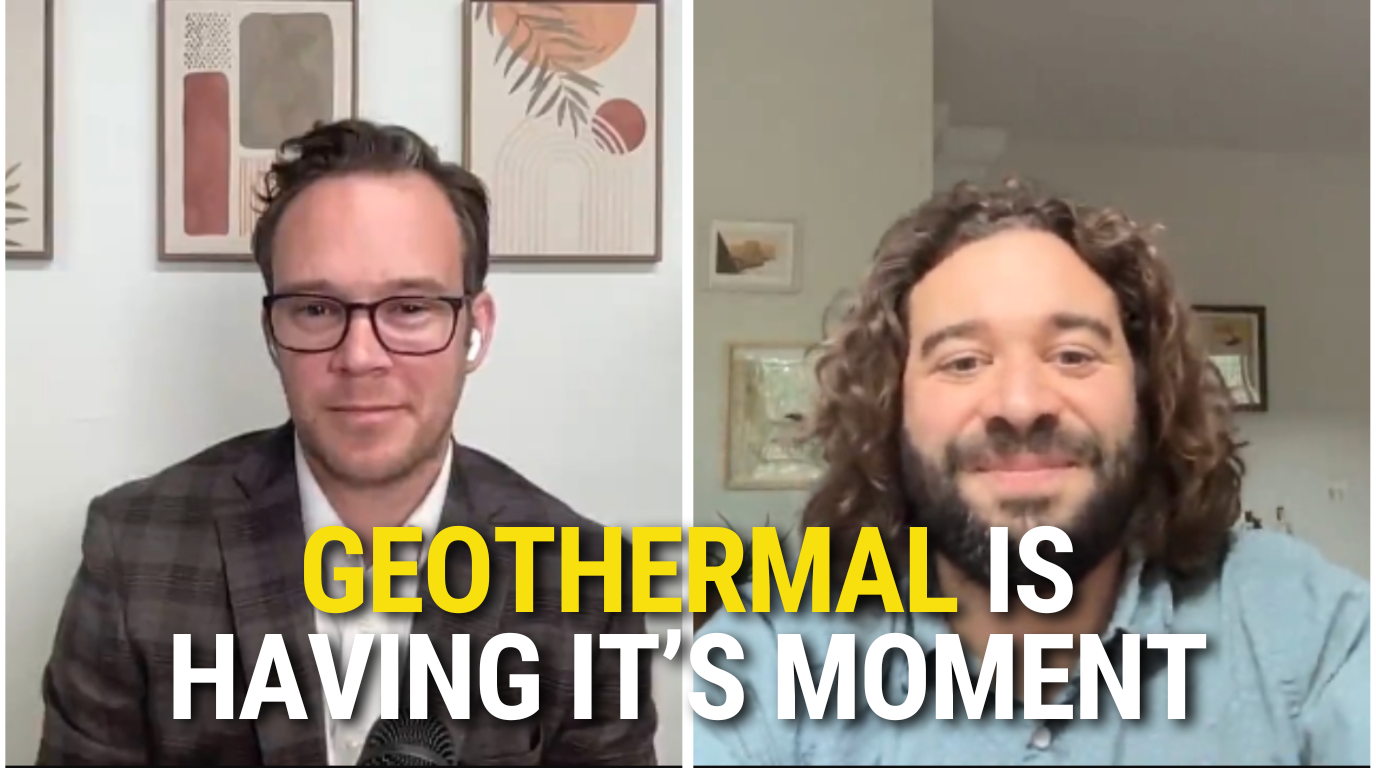
The timing is notable. Investment in geothermal is surging, and the technology has bipartisan support, backed by the Trump administration as well as Democrats and Republicans in Congress, with governors from both parties across the Mountain West lining up behind it. The four consortium states currently produce about 100 megawatts of geothermal electricity combined, a fraction of the roughly 300 gigawatts of potential the Department of Energy estimates exists across the country, three quarters of it in the West. Today we’re joined by Mike O’Connor, director of the Mountain West Geothermal Consortium and former career geothermal official at the Department of Energy, to talk about what’s standing between geothermal and that scale, why capital formation for early-stage site appraisal is the biggest barrier the industry faces, and what success looks like for the consortium over the next one to five years.
Chris Moyer: So before we get into the consortium, I wonder if you could just tell us a little bit about yourself. You served as a career geothermal official at the Department of Energy during both the Biden and Trump administrations. What drew you to this technology and what brought you into this new role?
Mike O’Connor: It’s a great question. I think I’m lucky because as a geologist, I got to enter the discourse a little bit earlier, because I was in the technical conversations five or six years ago. But at a high level, I was drawn to this technology for the same reasons I think it’s getting pressed today. I saw a really strong value proposition across a whole bunch of different areas. There’s true clean power, right? There’s no emissions output, there’s no fuel cost. It’s leveraging tech that we’ve already got, that’s proven and quite capable to do the thing that we need it to do.
It felt eminently feasible to me from an R&D perspective. Knowing what the geothermal industry needed to do to achieve scale felt a lot like things the oil and gas industry was already doing. And I saw the broad appeal it could have because of those assets. So I got sucked in right when Forge was getting going, in 2019. That was when I started working on geothermal. It’s been very exciting to watch it develop, and it’s how I got to this role today, because over those five or six years we watched the industry jump from one whose primary concern was R&D to one whose primary concerns are commercial.
CM: Yeah, I want to get into some of those in a second, but for those in our audience who aren’t as familiar with geothermal, I wonder if you could tell us a little bit more about what those benefits are. What’s the quick pitch on geothermal? Why does it work? How does it work? And why is it having a moment right now?
MO: Absolutely. Geothermal energy is a broad category of technology approaches that harness naturally occurring heat that emanates from the core of the earth….So what we’re doing is drilling holes into the earth to extract some of that heat via fluids. Those fluids warm up, we pull the fluid out of the earth, put it through a power plant, it spins a turbine, gives away its heat, and then we inject it back into the earth to get more heat. We effectively create a perpetual loop where we’re extracting the naturally emanating heat from the earth and it’s spinning this turbine.
…There are also approaches where companies are actually engineering the subsurface themselves. They’re using the best-in-class drilling tools that we’ve developed in the oil and gas industry, taking them below ground and applying them to hot water. They’re making new pathways that water can flow through in new environments, so you can create your own geothermal reservoir as long as you have hot rock — and hot rock is pretty common.
That’s why I think it’s having a moment. We’ve made this scaling step where we can unlock a lot more locations, a lot more resources, a lot more regions. We’ve seen that demonstrated in the field now a couple of times. That’s the base of the pyramid for why this is exciting. On top of that, there’s a lot of beneficial things happening for the industry that happen to coincide with good technical breakthrough timing. There’s demand for electricity, the thing this industry produces, growing for the first time in 30 years. There are political headwinds in a lot of the other energy generation areas that this industry isn’t facing. And there’s a supply chain advantage, where we can credibly say that workers trained in oil and gas need no extra training to do this. So it’s happening all at the same time. They’re a victim of good timing.
CM: Indeed. So the four states in this consortium currently produce about a hundred megawatts of geothermal electricity combined, and the DOE estimates that the U.S. holds about 300 gigawatts of potential, with three-fourths of that in the West alone. What is standing between where we are now and where we could be?
MO: It’s a commercially viable industry right now. So the barriers to getting to that 300 gigawatts you’re referring to are more financial, policy driven, and logistical.
One of the major ones we’re trying to attack is the hesitancy and uncertainty that comes with beginning a project in a new location where you don’t know very much. That’s a larger hurdle in a subsurface industry than in a non-subsurface industry. If you want to figure out your potential economic return for a solar farm, you probably need to spend about 15 minutes on an open source irradiance database. You take a look at how strong the sun is traditionally in a location, do a little quick math, and you’ve got your answer. For geothermal, that same set of calculations costs you about a hundred million dollars worth of drilling, subsurface modeling, and completions and testing. So although we know we can extract geothermal energy in many, many locations, we don’t know the price point of where it would be in one place versus another.
Getting over the financial hurdle to get sites appraised is, to me, the single greatest barrier we’re seeing right now, holding back widespread commercialization. Because as I’ve said, the demand is there and the supply chain is there — we need to find the capital formation up front. There are other important barriers too, around permitting architecture. It’s a new technology, there’s a lot of gray space…But the financing, getting folks to feel comfortable with the economic value proposition in a location — that appraisal step — that’s a huge one.
CM: So how did you land on these four states? Nevada — I have to share my bias, I worked for Harry Reid back in the day, so I’m curious about Nevada because I’ve spent time around Nevada and seen the geothermal that’s vibrant in the state. How did you land on these four states? Would you ever expand? What’s the thought process there?
MO: Last question first: we’re eager to expand. There’s no limit to the number of state officials we want to help as they design these policies. The membership began really organically, from the leadership of the states we have in our consortium being eager about scaling, having existing state programs already working on scaling geothermal power. For example, the Colorado Energy Office has a really vibrant grant-making program. The New Mexico Energy Office has about $22.5 million in grants. Nevada — we’re excited about, but I’d argue they’re sitting on their laurels a little bit. These states are here to try and snatch the mantle from one another. That’s really what they’re looking for, to claim market share.
CM: So if you look ahead a year from now, even five years from now, what will success for the consortium look like? I’m curious how you’re thinking about the day-to-day and then working towards those bigger picture goals. I assume it’s, you know, are we seeing more geothermal coming online, more adoption, better processes in place? But I wonder if you could talk about some of the key achievements you’re hoping to reach.
MO: Yeah, I think five years from now we want to see an industry at scale. That means deploying a gigawatt or more every year that comes online … The long-term vision is you see many drill rigs being used for geothermal explicitly across the Mountain West, in many different basins. We have a goal, internally, of seeing at least one new large utility-scale geothermal project by 2029 in all of our member states, and I think we’re probably already seeing the pieces for that. In five years, this industry will have grown so fast that the sky’s the limit, I’d say.
But in one year, we have some pretty tangible outcomes. The primary one is creating financial tools and mechanisms to help investors and developers share the risk at that early stage, when they’re not sure what the economics might be of a new geothermal plant … The second area — utilities are also interested, but they move a little slower because they’re regulated in most cases. We’re trying to help those regulated utilities understand how deployment of this technology works, how they get it into their integrated resource plans…
And the third one is kind of esoteric, but I think it’s really clever. There’s a hundred years’ worth of old data — mining data, oil and gas data — from exploring America’s Mountain West since the turn of the last century. All that data can be useful today with new AI earth system models, to help us better guess where the good heat is and where the good rocks are.
CM: Absolutely. That’s really fascinating to think about, and all the potential that’s there. Last question, Mike. What’s something about you, either professionally or personally, that would surprise our audience?
MO: Probably wouldn’t surprise people who know me, but I’m the musician for a comedy improv team here in Washington, D.C., called iMusical, and everyone should go see them at Studio Theater. It’s an excellent way to completely leave this brain behind and go put your brain somewhere else.
Check out our recent conversations:
WATCH: Solar’s Journey From ‘Brink of Extinction’ to Manufacturing Renaissance
Echo’s Interview with Gov. Wes Moore
WATCH: Mike O’Connor on the Mountain West Geothermal Consortium & the Case for Faster Deployment
Sign up for our newsletter
Receive updates on our work, industry news, and more.