Morgan Caplan
Senior Communications Manager
A new study from the Corporate Energy Buyers Association (CEBA) finds that restricting new solar and wind development in the U.S. could cost American ratepayers an additional $121.2 billion over the next seven years. The finding lands at a pivotal moment: despite a shifting political mood in Washington, corporate clean energy buying just had its biggest year on record, and 2026 is on pace to top it.
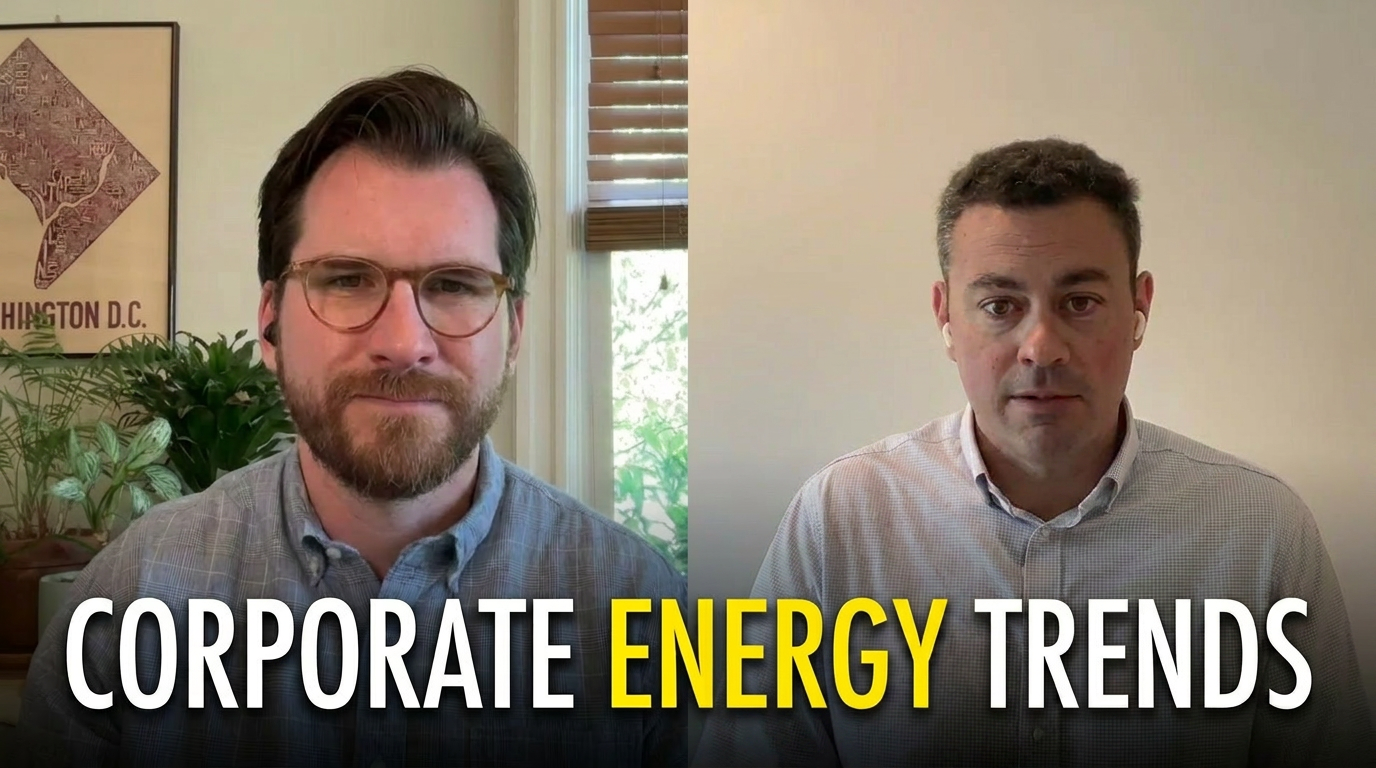
CEBA represents more than 300 of the world’s largest energy buyers and their partners across nearly every major economic sector, from hyperscaler data center operators to manufacturers, retailers, and food and beverage companies. Its members collectively represent more than $40 trillion in market capitalization, and the organization serves as a trusted, nonpartisan advisor to business leaders, policymakers, and energy system planners. Today we’re joined by Rich Powell, CEO of CEBA, to talk about what’s driving the surge in corporate clean energy demand, why permitting reform is the single biggest lever for lowering costs, and how he’s spent two decades building bipartisan support for clean energy in Washington.
Dan Crawford: Why don’t you tell us a little about your background and how you came to lead CEBA?
Rich Powell: I’ve had the honor of leading CEBA for the last two years, since 2024. And what two years those have been, to be really involved in clean energy buying, or energy buying in the US economy and increasingly around the world. I came to CEBA from another fantastic organization called ClearPath, which I helped found about a decade ago and ran for a bunch of years. And prior to that, I was in the private sector at McKinsey and Company, in the sustainability and energy practices.
DC: And for the folks who might not be familiar with the organization, who does CEBA represent, and what kind of policies are you advocating for in Washington?
RP: So CEBA has more than 300 member companies. And the easiest way to say it is, if you buy a significant share of American electricity, you’re probably a member of CEBA. We have all of the very large hyperscale data center operators and virtually all the developers. We have most of the large advanced manufacturing companies in the country — General Motors, for example, was one of our founding members and remains very, very active, alongside folks like Lockheed Martin, and very advanced manufacturers and designers like Apple, doing consumer electronics. We also have large players in chemicals, petrochemicals, and agriculture — everybody from Cargill to ExxonMobil — and a lot of large food and beverage players, like PepsiCo and Heineken.
And also a great representation of very large-scale retail — Walmart was another one of our founding members, and Target, folks like that. Everybody is brought together with this shared mission to advance low-cost, reliable, carbon emissions-free electricity systems. And we do that through all the levers that a business association can use to advance this together.
So we help continue to expand the practice of corporate clean energy buying — training new companies on how to do voluntary clean energy buying. We’re very involved in the corporate carbon accounting space, which sounds like a really niche topic, but actually ends up being one of the most important things that governs how the $40 billion-odd voluntary renewable energy certificate, market runs globally. We’re also very involved in policy on behalf of the members — at the federal level, and also at the subnational level, in states and power markets around the US. We also do it in APAC, through our global program in a couple of countries that are really important to how our folks operate. And then lastly, we do analysis and thought leadership on behalf of the industry, to help move the narrative in ways that encourage more clean energy built economically around the country.
DC: Yeah, I’d love to talk about that new study. So restrictions on new wind and solar resources, your study shows, could increase energy prices by $121.2 billion over the next, I think it was seven years. That’s a pretty big number. What are the implications for your members if that increase came to pass? What do you think policymakers should do with this information?
RP: Big number. It’s a big number — it’s a big industry. Well, a lot’s at stake when electricity system demand is growing and then we put constraints on any of the different technologies that could come in and economically supply that new demand. And unfortunately, we’ve now had multiple presidential administrations back to back who’ve had favored technologies and have been putting constraints on the less favored technologies, and that is what it is. We also have a permitting system, and this is a long-overdue thing that’s needed to be fixed, that just generally constrains all energy infrastructure projects of all types.
So we tried to look at the cumulative impact of all that, plus new constraints being put on specific types of new energy resources, ‘What if you just didn’t allow new things to be built over the next seven-year period?’ And unsurprisingly, when you have rapidly growing demand and you constrain a lot of the new supply, especially as everything sitting in the interconnection queues around the country trying to come onto the grid, the vast majority is new solar and wind. When you constrain all that new supply, you’re going to be in for a world of hurt. You’re going to have very significant increased costs.
That $121 billion number for residential ratepayers is across both their electricity and their gas costs. We were also able to model the electricity cost increases for our commercial and industrial customers as well. When you constrain the most economical new resources — which in many parts of the country, almost every part of the country, is a lot of new solar and wind coming onto the grid — it means you’re going to have to go to the next most economical thing, which in this case is gas. But the more pressure you put on the gas power system and the gas supply, that increases the price of everybody’s heating costs and cooking costs.
So there’s that second-order effect that’s all captured in this for the residential ratepayers. And then our C&I customer base costs go up a lot as well — about $40 billion of that $121 billion is borne by us. But we care not just about our direct costs, we care a lot about the residential ratepayers too, because those are dollars that would otherwise go to our consumer electronics, our stores, our pharmaceuticals — all the amazing things we have to offer. They’re going to pay these electricity bills instead.
We’re really in a remarkable window right now in Congress where we’ve got a ton of bipartisan alignment that could result in a grand bargain — on reforming our existing permitting system, on creating a standard for energy certainty on reforming our transmission system as part of this. There’s just an enormous opportunity ahead of us if we can get this right.
DC: One of the things I find very interesting about CEBA is your members all have very different motivations for wanting to purchase clean energy. Certainly some are motivated by climate, by pollution, by social pressure, but others are motivated purely by the economics. So 2025 came around, Trump came back into office, and it seemed like everybody was kind of writing the clean energy industry off. But your research shows 2025 was actually a record year for corporate clean energy deals, and 2026 is looking like it’s going to even surpass 2025. What does that tell us about the motivation behind some of your corporate energy buyers, and where do you think the market is headed?
RP: The interesting thing in the 2025 numbers is that by capacity, nuclear has become the second most important thing that we buy. And actually by generation, it slightly edged out solar in terms of the number of megawatt-hours we’re now contracted to buy. It’s even more important. So there’s a lot to like across all of those. We also buy hydro, geothermal, even gas with carbon capture on the back end, so it extremely greatly reduces the emissions.
Solar, wind, and batteries stand out for two reasons. First, speed to power — so many of those projects have been sitting in the queue for so long and are now ready to go, and frankly, they’re so quick to build. Once you break ground on a solar project, it can be online in a dozen months, which is a lot faster than most other infrastructure we build in this country. Our members love nuclear and have contracted for a lot of it, but the build timeline is long — the last reactors built in Georgia took about a decade.
Second, the capital structure. Solar, wind, geothermal, nuclear, to a lesser extent, are weighted toward upfront capital rather than long-term operating costs, which gives a lot more certainty, about what it’s going to cost long-term. These technologies let them do that with long-term PPAs in a way that’s much more difficult with grid power, or buying from a natural gas plant with a highly variable fuel price. So making that bet not only gives you certainty, but you’re also effectively betting you’ll be able to lock in a better price now, even if it’s a little more expensive today — because between economic growth and all of these constraints and all of this new demand coming into electricity, the future cost is probably going to be more than where it is today.
DC: Your report mentions permitting, mentions transmission, it mentions tariffs, expiring tax credits, all as concerns for corporate energy buyers. That’s a pretty long list. If you could fix just one of those, what do you think would move the needle most?
RP: If you have to fix one thing, you fix permitting. Permitting is the thing that allows everything else to work better. If we did nothing but fix permitting, you can build all generation faster and cheaper. The cost of finance goes down. Even if you don’t have the beautiful national transmission siting regime, every individual transmission line is still faster and cheaper to build if you’ve got the permitting.
You know, our big analysis last year, like the one we’ve just done with NERA this year, was to look at what would happen if the tax credits went away, and to show that unfortunately there will also be a very significant price increase due to the expiration of those credits. We’re already seeing prices that have accelerated pretty materially in the past two years, and we expect those prices to go up even further. But in a lot of places, it’s going to become more and more difficult to purchase new wind and solar in particular, especially if we don’t take care of the permitting issues.
DC: You were formerly the founder and the CEO of ClearPath, which is a conservative clean energy advocacy organization. Why should conservatives support clean energy, and how do you think we can bridge the political divide?
RP: Well, let me just correct the record — I’ll say a founder. The great Jay Faison founded ClearPath and remains the chairman of ClearPath, and is just a wonderful, very visionary, incredibly generous person and philanthropist. It was focused on finding a way to give conservative policymakers an ally and a resource to help craft their own version of clean energy and climate policy, in the way that, in DC, a left-of-center policymaker has an embarrassment of options of places that they could go to get advice and guidance and policy ideas. And conservative policymakers just weren’t seeing that in the same way. So we helped create a platform heavily focused on innovating new advanced clean technologies in the US, removing regulatory constraints and permitting requirements so that we could build enough to demonstrate them here and then export them to the rest of the world.
We were very involved in things like the Energy Act of 2020 and the Bipartisan Infrastructure Law in 2021, that helped put in place a lot of the foundational things. It’s been a pretty satisfying through-line for me between these two roles.
DC: What lessons have you learned about bridging political divides and finding common ground, in your work at ClearPath and at CEBA?
RP: Things are so tribal in DC, and people tell these stories about the other side. And I just always start by assuming good intent Just start by assuming that, if somebody’s opposed to what you’re doing, it’s not because they’re evil, or they’ve got a fundamentally different value set than you do.
I think a lot of conservative policymakers had really significant questions about a system that relied entirely on intermittent resources, which at the time when we started ClearPath was more of the dominant kind of Democratic line, that things should be a hundred percent renewable. And a lot of conservative policymakers were like, how’s that going to work? Do we actually have enough capacity and storage and all that kind of other stuff to make that happen? And now, obviously, they had a really good point — we did need to do more on clean-firm resources and long-duration energy storage. So that was a valuable contribution that conservative policymakers brought into our national conversation about clean energy and climate.
DC: Last question, a fun one. What’s something about you that would surprise people?
RP: My family’s business growing up was a hot air balloon charter ride business, so I’m an FAA-certified commercial hot air balloon pilot. I don’t get to do it much these days, living in DC’s controlled airspace, but the license never expires. I’d just need to get current again before taking the controls solo. I’ve flown exactly once in the last decade. There are maybe a few hundred of us in the country.
DC: That might be the best answer we’ve gotten on this show. Rich Powell, thank you so much for joining us, this was a great conversation.
RP: Thanks so much for having me, Dan. Really enjoyed it.
Check out our recent conversations:
WATCH: Solar’s Journey From ‘Brink of Extinction’ to Manufacturing Renaissance
Echo’s Interview with Gov. Wes Moore

WATCH: Mike O’Connor on the Mountain West Geothermal Consortium & the Case for Faster Deployment
Sign up for our newsletter
Receive updates on our work, industry news, and more.